
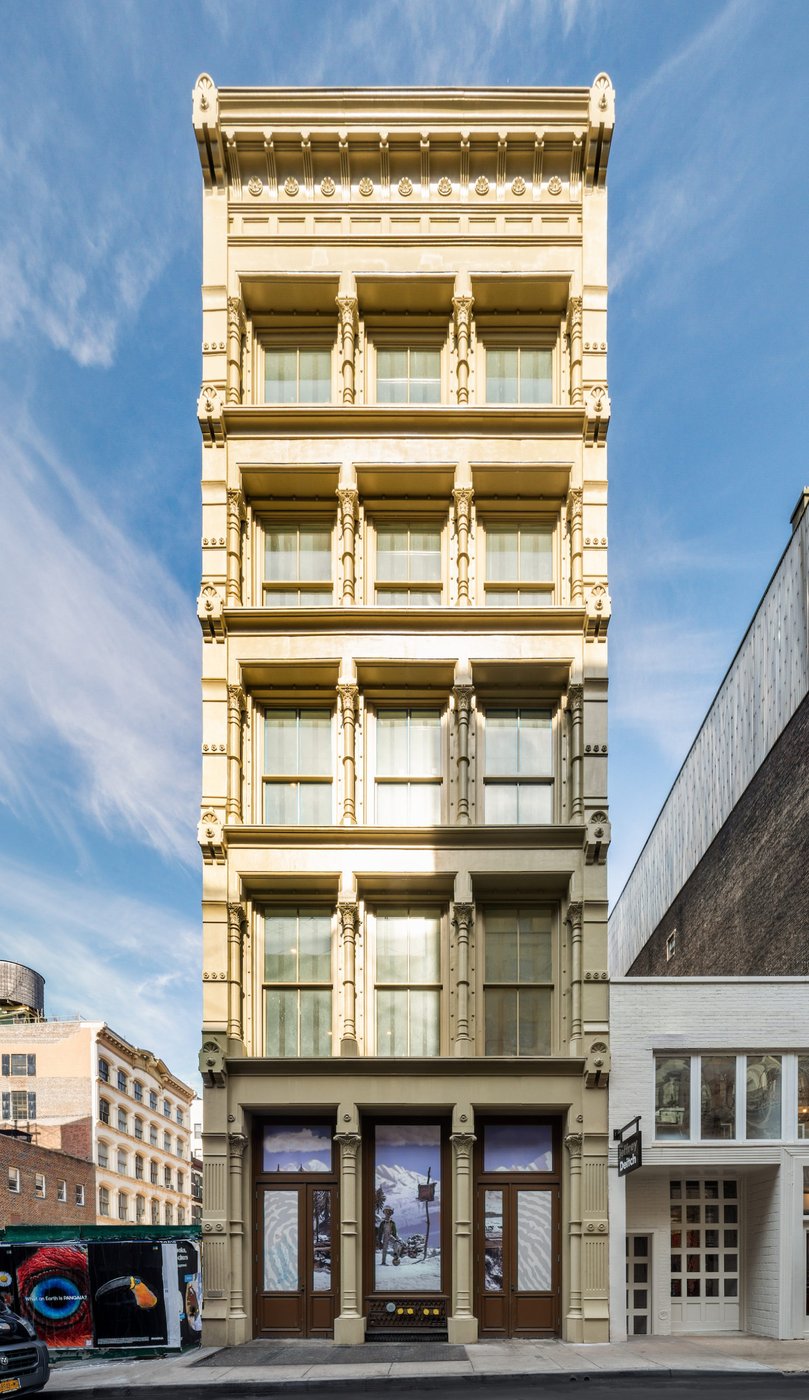
The story begins, as many contemporary art stories now do, not with an artist but with an asset.
An Aestheticized Impasse
When the private equity consortium Meridian Stone Capital quietly acquired 74 Grand Street, a nineteenth-century cast-iron landmark in SoHo, for a reported $90 million, the transaction initially appeared to follow a familiar trajectory. The building occupied one of the most valuable corridors in lower Manhattan, a neighborhood whose industrial past has been repeatedly translated into increasingly abstract forms of capital—first through manufacturing, then through culture, then through luxury retail, and finally through finance itself. The acquisition seemed destined to culminate in the standard cycle of redevelopment, optimization, repositioning, and monetization that has defined the district for decades.
Yet the building presented a peculiar problem. While its location possessed extraordinary commercial value, its landmark status transformed demolition into a politically and economically expensive undertaking. Preservation reviews, public hearings, legal challenges, architectural oversight committees, and a growing coalition of neighborhood advocacy groups threatened to convert what appeared on paper to be a straightforward real-estate play into a prolonged battle over cultural memory. The structure could not simply be erased. It had accumulated too much history, too much symbolism, too much collective projection.
Faced with this impasse, the owners pursued a strategy that increasingly characterizes the contemporary relationship between art and capital: rather than remove the obstacle, they would aestheticize it.
A Collaboration With Capital
The holding group entered into a collaboration with conceptual artist Claire Lan, whose practice frequently examines the conversion of social, symbolic, and institutional systems into speculative instruments. Together they proposed an intervention that was at once architectural, financial, performative, and absurdly literal. Instead of demolishing the building, they would burn it.
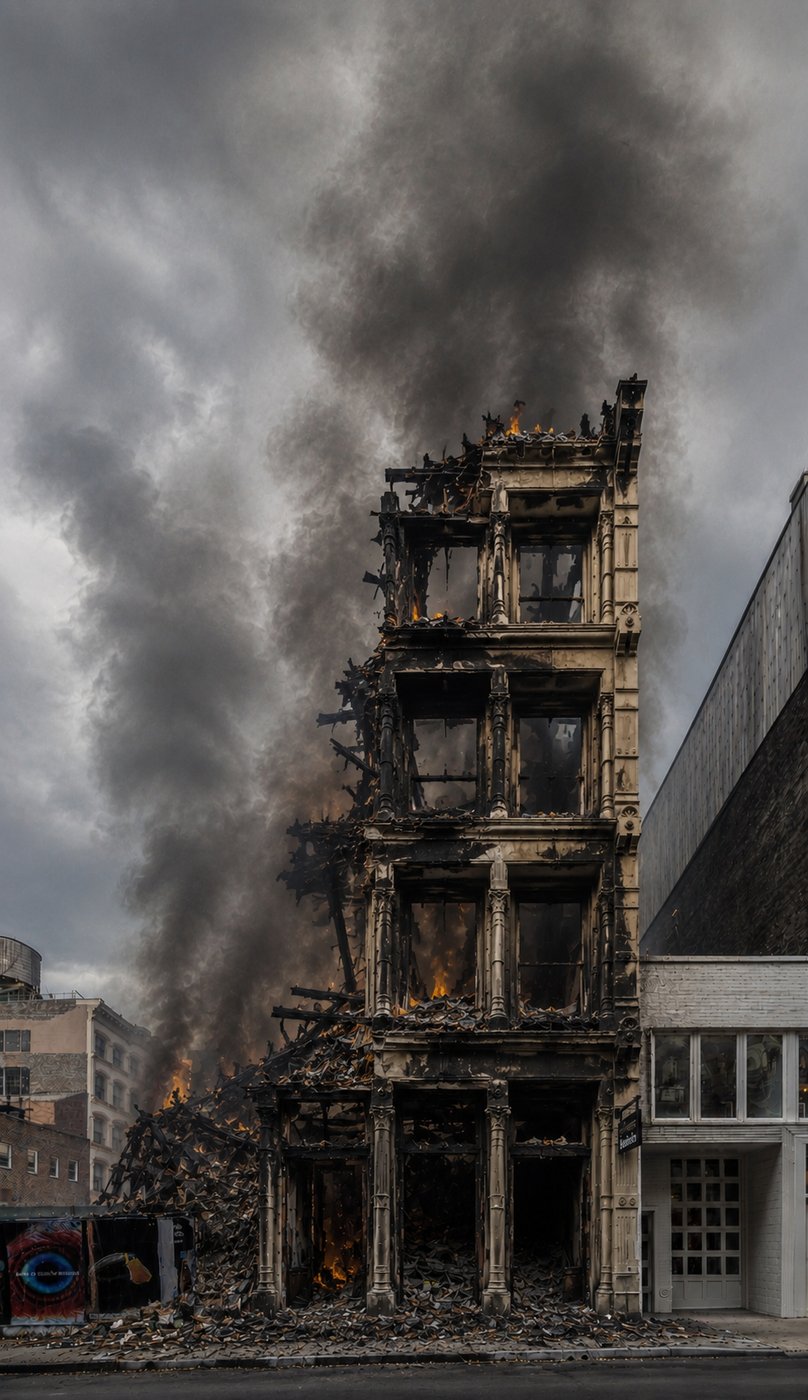
The resulting work, 74 Grand, unfolded through a carefully orchestrated combustion event that transformed the six-story structure into a partially collapsed ruin. Much of the building’s interior was reduced to ash and twisted steel. Entire sections of the facade disappeared. Yet a fragment remained. Rising above the debris field, several stories of the original cast-iron wall continued to stand, suspended between preservation and destruction, monument and accident, architecture and image.
What emerged was neither a building nor its absence, but a third condition increasingly familiar to contemporary culture: the ruin as asset.
The Ruin as Asset
Visitors arriving at the site encounter not a completed object but an unresolved negotiation between competing systems of value. The surviving facade functions simultaneously as historical artifact, sculptural form, financial instrument, legal workaround, and public spectacle. One is reminded less of traditional land art than of the peculiar afterlife of late capitalism’s abandoned infrastructures—except here abandonment has been deliberately manufactured and meticulously managed.
The irony, of course, is impossible to ignore. For decades, preservationists argued that the building possessed cultural significance beyond its market price. Their opponents maintained that its highest purpose lay in economic productivity. The artwork resolves this conflict through an elegant act of institutional alchemy: by damaging the building, it became more valuable than either side imagined possible.
Recent appraisals reportedly place the work’s value at approximately $180 million, double the original acquisition price. The increase cannot be explained through square footage, rental income, retail potential, or traditional development metrics. The value now resides elsewhere. It resides in narrative, in visibility, in controversy, in the symbolic economy that increasingly governs contemporary culture. The building no longer generates returns because it houses activity; it generates returns because it has become a story.
Seen from this perspective, 74 Grand may be less an artwork about destruction than an unusually clear portrait of our present condition. The project reveals a world in which historical preservation, real-estate speculation, institutional critique, and contemporary art no longer operate as separate domains but as overlapping financial languages capable of translating almost any object into capital. The fire merely made visible a process already underway.
Standing before the charred remains of the structure, one experiences an unsettling uncertainty regarding what exactly has occurred. Has a landmark been destroyed? Has a sculpture been created? Has a financial instrument been invented? Or has the project simply exposed the extent to which these categories have already collapsed into one another?
In the end, the smoke may be the most truthful component of the work. It lingers as evidence of a transformation that remains difficult to categorize, hovering between loss and appreciation, tragedy and speculation, disappearance and value creation. What burned at 74 Grand Street was not merely a building. It was the distinction between architecture and asset, preservation and performance, ruin and investment. The resulting artwork leaves behind a question that feels increasingly unavoidable: in an economy where everything can become culture and culture can become capital, what, if anything, is left that cannot be turned into art?